
What an independent design review covers for stadium technology
A stadium's technology systems are designed by several parties, built by others and operated for decades by someone else again. An independent design review checks that the design will actually deliver what the owner needs, before money is committed to equipment and installation.
This article explains what an independent review covers for stadium and arena technology, when to commission one, and what you should expect to receive.
Why "independent" matters
Most technology designs are prepared by a consultant or contractor who also has a stake in what gets built. An independent reviewer has no product to sell and no supply role on the project. Their only job is to test the design against the client's requirements, the relevant standards and the way the venue will really be operated, for both everyday use and major events.
That separation is what makes the findings useful: recommendations follow the project's needs, interoperability and lifecycle value, not a product catalogue.
What gets reviewed
A thorough review looks at each system on its own and at how the systems work together.
Requirements and design criteria
Are the client's operational requirements clearly written down? Is it clear which requirements apply in legacy (day-to-day) mode and which apply in event mode? Many problems later in a project start with criteria that were never agreed.
Professional audio and acoustics
Coverage, sound pressure levels and speech intelligibility (STI) across seating bowls, concourses and hospitality areas, along with the room acoustics (RT60) that affect them. A review checks that the predicted performance is backed by modelling, not just by loudspeaker counts.
Large-format LED and digital experience
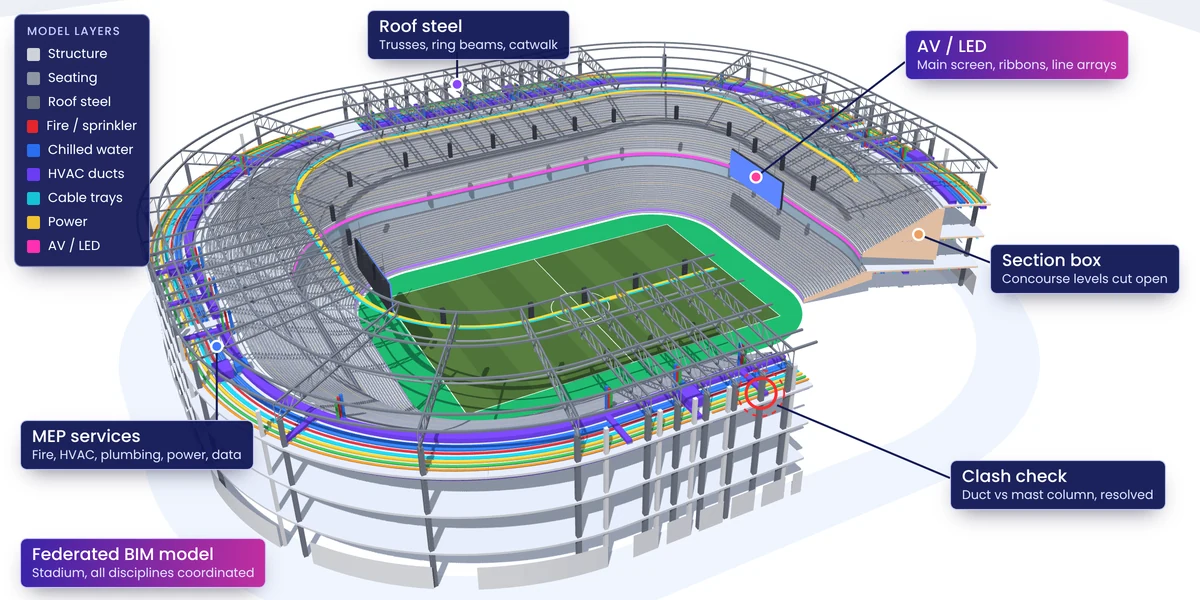
Main screens, ribbons, scoreboards, IPTV and infotainment. Reviewers test screen sizing and pixel pitch against real viewing distances and sightlines, and check structural loads, power, content routing and maintenance access.
Life safety and PA/VA
Public address and voice alarm design, emergency interfaces with fire and security systems, and whether the design preserves essential local operation and meets the requirements of the approving safety authority.
Broadcast and event interfaces
Broadcast connectivity, camera positions, approved feeds and production interfaces for matches, ceremonies and live events, so that overlay teams can plug in without re-engineering the venue.
Control, networks and cybersecurity
Centralized command and control, monitoring, AV-over-IP and the converged network behind it: segregation, redundancy, authorized control and local resilience if a central system fails.
Coordination, specifications and BOQ
BIM and MEP coordination, interface matrices between contractors, performance specifications and the bill of quantities. Gaps here become variations and delays during construction.
When to commission a review
- At concept or high-level design, when changes are cheapest and the architecture can still move.
- Before tender, so specifications and BOQ are complete, measurable and vendor-neutral.
- Before factory and site acceptance (FAT/SAT), so acceptance criteria match what was designed and promised.
Early reviews prevent the most cost. Later reviews protect acceptance and handover.
Common issues a review catches
- Speech intelligibility targets stated but not demonstrated.
- Screens sized for the drawing, not for the furthest seat.
- No safe maintenance access for LED, loudspeakers or rigging.
- Unclear responsibility at interfaces between AV, ICT, MEP and structure.
- Event-mode needs (broadcast, overlay, Fan Zones) left to "later".
- No plan for spares, support contracts or technology refresh.
Designing the right solution: protect CAPEX, keep OPEX in view
A design review is not only a technical check. It is the best moment to make sure every riyal of capital spend is justified and that the venue will be affordable to run for its whole life. In practice that means:
- Save CAPEX: right-size permanent infrastructure and remove over-specification, so the client does not pay for capacity the venue will never use.
- Protect CAPEX: make sure what is bought is interoperable, maintainable and not locked to one supplier, so the investment keeps its value and is not replaced early.
- Phase where it makes sense: delay purchases where technology moves fast, and plan reusable interfaces for event overlay instead of permanent capacity for a few event days.
- Keep OPEX in view: consider energy, cooling, maintenance access, spares, support contracts and refresh cycles during design, when they are cheapest to influence.
What you should receive
A useful review ends with clear, actionable outputs: a review report with findings ranked by risk, a comments log the designer can respond to, a compliance matrix against requirements and standards, and recommendations that take capital cost, operating cost and lifecycle into account.
How EvoPro can help
EvoPro provides design and independent design review for stadium digitalization, connecting professional sound, large-format LED, IPTV, infotainment, broadcast and command-and-control systems with legacy operation and event overlay. Our team's experience includes technology design, design review and engineering support across the eight host stadiums of FIFA World Cup Qatar 2022™, the AFC Asian Cup and Arab Games 2011 stadium upgrade programme, the IHF Men's Handball World Championship 2015, the Doha Asian Games 2006 across more than 107 venues, and design criteria for 35 indoor arenas and 17 outdoor courts for the Qatar Olympic Committee. Because we do not supply on projects we advise, our recommendations follow your objectives.
Contact us to discuss a review for your venue, or explore our full scope of services.