
Planning outdoor LED billboards in Qatar: visibility, pixel pitch and heat
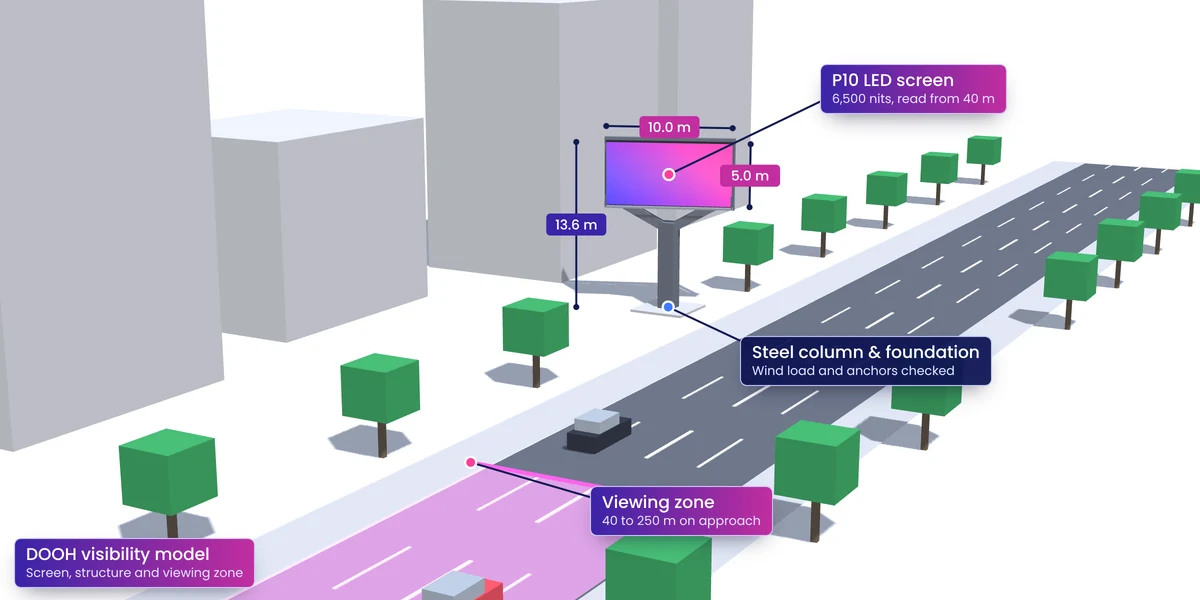
An outdoor LED billboard only earns its cost if the right people can see it, read it and trust it to stay on. In Qatar that means planning for fast roads, strong sunlight, summer heat and dust from the very first site visit.
This article walks through how an independent DOOH (digital out-of-home) consultant plans a roadside or landmark screen, from choosing the location to handing over a network that runs around the clock.
1. Prove the location before you specify the screen
The most expensive mistake in DOOH is a well-built screen in the wrong place. A visibility study tests each candidate site before any equipment is chosen. It typically covers:
- Viewing distance and angle: how far away drivers or pedestrians first see the screen, and from which directions.
- Sightlines and obstructions: trees, bridges, signage, lamp posts and future buildings that could block the view.
- Approach speed and dwell time: how many seconds a passing driver actually has to read the message.
- Sun and glare: the screen's orientation through the day, and when direct sunlight will wash it out.
The result is a short list of locations that are proven to work, each with a recommended screen size and viewing zone.
2. Match pixel pitch and screen size to the viewer
Pixel pitch is the distance between LED pixels. A smaller pitch looks sharper close up but costs more, uses more power and adds weight. The right choice depends on the minimum viewing distance at that site, not on the finest pitch a supplier can offer.
Screen dimensions and resolution should also suit the content. Agreeing aspect ratio, resolution and pixel mapping early means advertisers' artwork is never cropped or stretched, and content zones (for example a fixed brand panel beside a rotating ad slot) can be planned from day one.
3. Specify for Qatar's climate
Outdoor displays in the Gulf work harder than almost anywhere else. A vendor-neutral specification should set clear, testable requirements for:
- Brightness and automatic dimming, bright enough for midday sun and dimmed at night so the screen is comfortable for drivers and neighbours.
- Contrast and colour uniformity, so images stay consistent across every module.
- Ingress protection (IP rating) against dust and water, with the rating verified for the front and the rear of the cabinet.
- Thermal performance, so the screen and its electronics run reliably through the summer without early failures.
- Photobiological safety, evidenced by manufacturer test reports rather than marketing claims.
4. Engineer the structure and power
A large-format screen is also a structure. Wind load, foundation and anchoring criteria, maintenance access (front or rear service) and the power supply all need to be defined and checked with qualified structural and electrical engineers. For screens on façades, the display has to be integrated with the architecture, not bolted on afterwards.
5. Plan control, monitoring and operations
A DOOH network is only as good as its uptime. The design should define how content is managed and scheduled, how proof-of-play is reported to advertisers, and how every screen is monitored remotely around the clock, with cyber-secure access. Maintenance plans, spare parts and service-level agreements should be in place before handover, not after the first fault.
Protect the investment: CAPEX and OPEX
A DOOH screen is a long-term asset, so the cheapest screen to buy is rarely the cheapest screen to own. Good planning keeps both numbers under control:
- Save CAPEX: choose the pixel pitch and size the location actually needs. A finer pitch than the viewing distance requires adds cost, weight and power with no benefit to the viewer.
- Protect CAPEX: specify brightness, IP rating and thermal performance for Qatar's conditions, so the screen does not fade or fail years before its expected life.
- Reduce OPEX: automatic dimming, efficient power supplies and good ventilation cut energy and cooling costs; easy service access and standard spare modules cut maintenance time.
- Keep options open: a vendor-neutral control system lets the owner add screens or change suppliers later without replacing the whole network.
A quick planning checklist
- Visibility study completed for every site
- Pixel pitch justified by minimum viewing distance
- Brightness, dimming, IP and thermal requirements written as measurable criteria
- Structural, wind-load and power design verified
- Content management, proof-of-play and remote monitoring defined
- Maintenance, spares and SLA agreed before handover
- CAPEX justified and lifetime OPEX (energy, cooling, maintenance) estimated
How EvoPro can help
EvoPro provides independent DOOH advisory for roadside, retail, transport and public-realm networks in Qatar, from site and visibility studies to specification, centralized management and acceptance. Our experience includes an outdoor LED billboard network operating across Doha since 2015, as well as digital media for Hamad International Airport, Lusail Boulevard, Msheireb Downtown Doha and several of Qatar's major malls. Because we do not supply equipment, our specifications stay vendor-neutral.
Contact us to plan your next screen or network, or see our DOOH services.